Misc
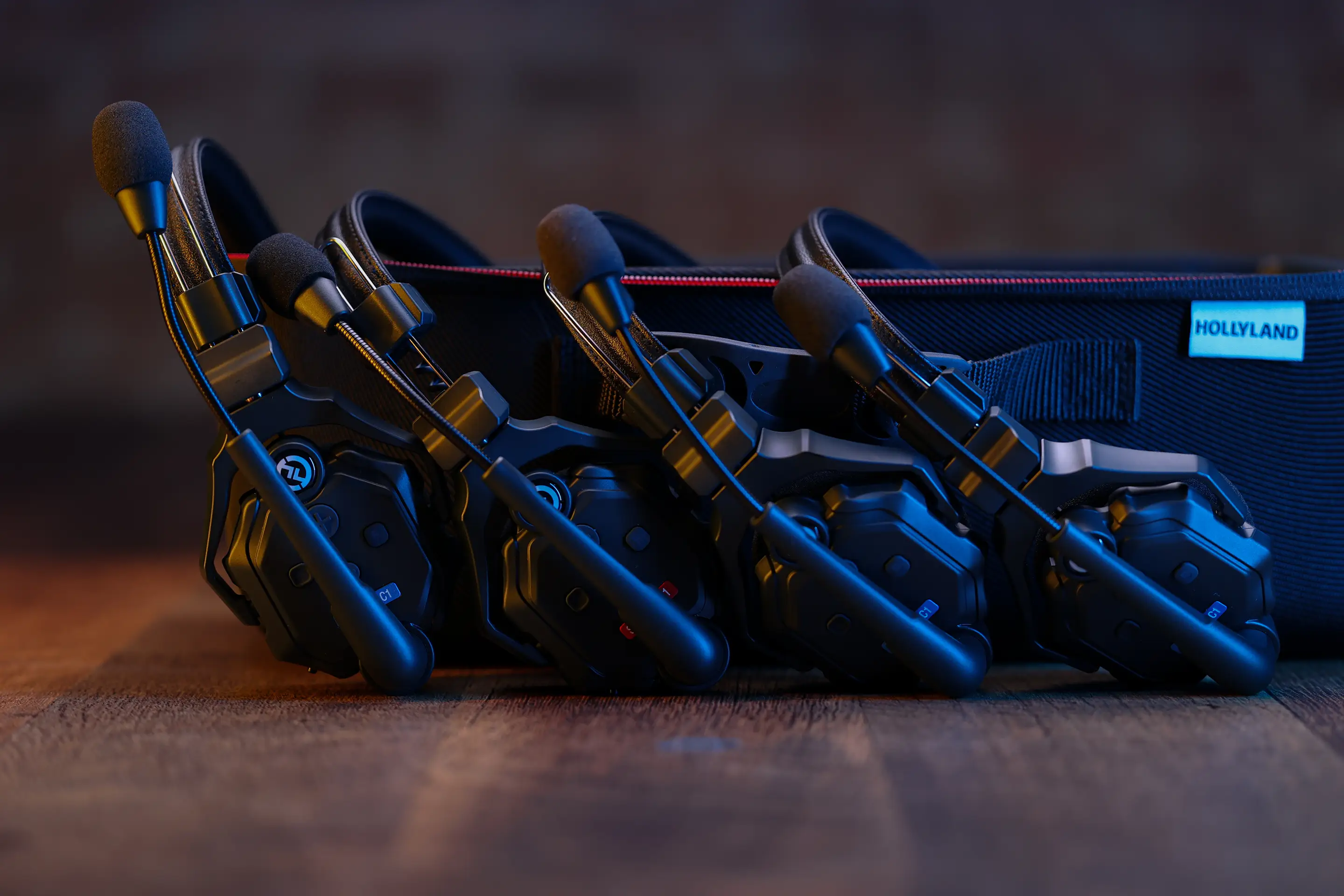
Hollyland Headset.
Wireless intercom headsets that keep our crew talking across a venue. On multi-camera weddings and live events, coordination is the difference between catching a moment and missing it.
Specs
- Type
- Full-duplex wireless intercom headsets (Hollyland Solidcom)
- Wireless
- DECT, 1.9 GHz band, encrypted
- Range
- Up to 1,100 ft (350 m) line of sight
- System size
- Up to 8 headsets on one system
Talking without shouting.
On a wedding day the crew is spread across a building. One operator is at the altar, one is on a long lens at the back of the room, someone is watching the door for the entrance. On a commercial set, the director is at the monitor and the camera is forty feet away behind a light stand. In both cases the alternative to an intercom is hand signals, text messages that arrive late, or someone jogging across a room they're not supposed to be walking through. The Hollyland intercom headsets exist to remove all of that.
They're full duplex, which is the part that matters. Full duplex means everyone can talk and listen at the same time, like a phone call, with no push-to-talk button to find and no waiting for someone to finish. Nobody is fumbling for a key while the moment happens. You just say "she's coming out now" and the other operator is already moving.
Why DECT and not Bluetooth or Wi-Fi.
The system runs on DECT in the 1.9 GHz band. That band is deliberately not the crowded 2.4 GHz neighbourhood where every phone, camera trigger, venue Wi-Fi network and video transmitter is already fighting for air. A reception hall with three hundred phones in it is one of the most hostile radio environments you will ever work in, and an intercom that drops out there is worse than no intercom at all, because you'll trust it right up until the moment it fails. The link is encrypted too, which means the venue's audio and the crew's chatter stay between the crew.
Range is around 1,100 feet line of sight, and a system carries up to eight headsets. That covers a church, a reception hall, a warehouse or a corporate campus without anyone standing in a specific spot to stay connected.
Where we use them.
- Multi-camera weddings — calling the entrance, the first kiss and the exit so no operator misses a beat they can't get back.
- Live events and conferences — cueing camera moves between speakers without a word on the room mics.
- Commercial and corporate shoots — the director talking directly to the operator instead of relaying through three people.
- Automotive and rolling shots — where the camera vehicle and the hero vehicle are nowhere near each other.
- Anywhere the second camera is out of sight of the first.
The headsets are single-ear, which sounds like a minor detail and isn't. You need one ear on the room — on the vows, on the music cue, on the sound of a car coming — while the other ear is on the crew. Two closed ears on a live event is a good way to miss the thing you're there to shoot.