
Filters
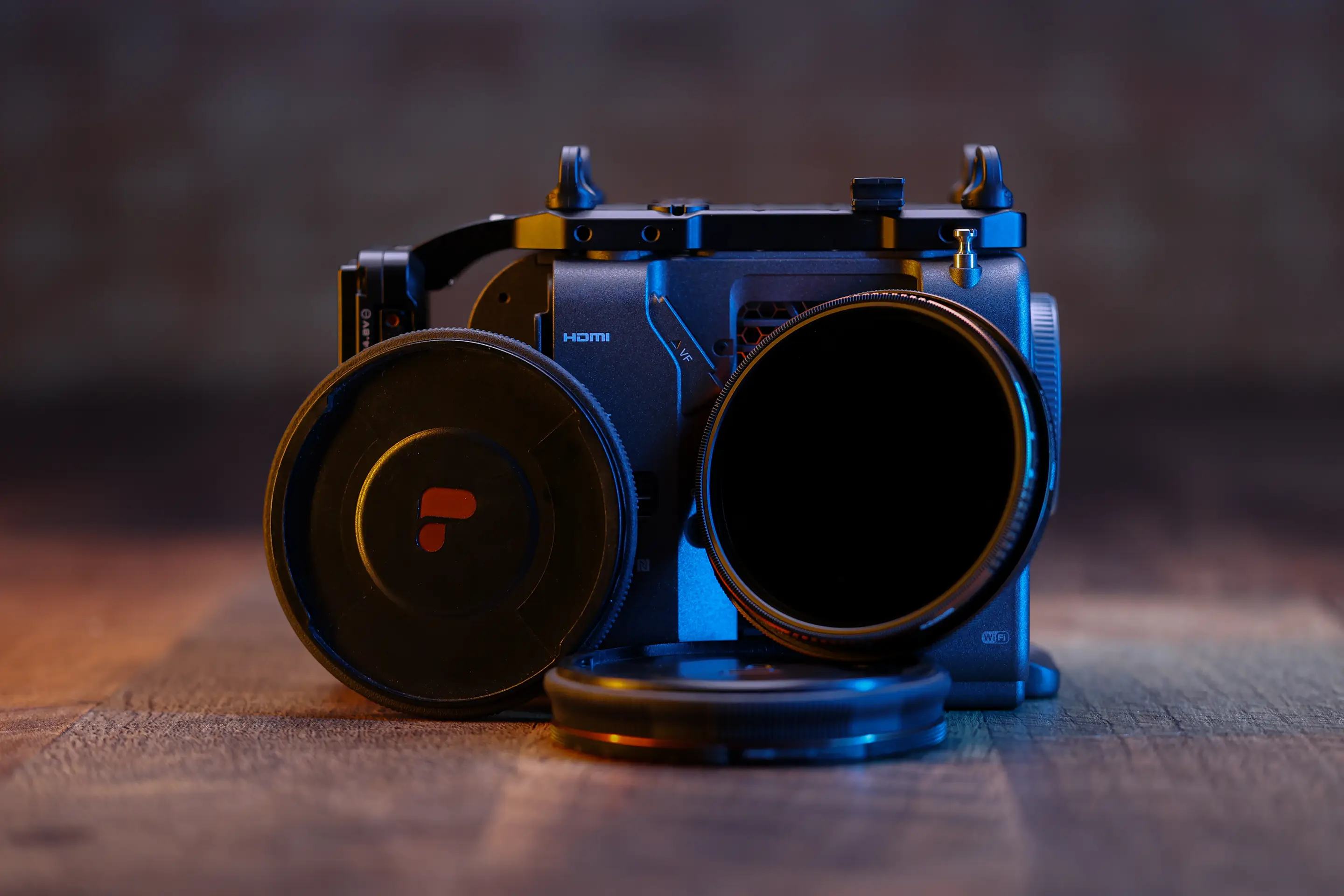
82mm 6-9 ND.
A stronger 6–9 stop variable ND for bright, open sun. It's what makes a wide-open aperture possible mid-afternoon on exterior automotive and wedding shoots.
Specs
- Filter thread
- 82mm
- Type
- Variable neutral density
- Range
- 6-9 stops
For the days the sun wins.
This is the heavy variable ND, and it comes out when the light is genuinely harsh: midday sun, open pavement, snow, water, a white car in a parking lot in July. In those conditions a 2-5 stop filter runs out of road. Something has to give, and without enough ND the thing that gives is either the shutter or the aperture, both of which are decisions we made for a reason.
The reason is simple. A 180-degree shutter is what makes motion look the way our eyes expect from film. Push the shutter to 1/2000 to fight the sun and the footage picks up a hard, strobing edge on every pan and every step. A wide aperture is what separates a subject from the background. Stop down to f/16 and the background comes forward and the shot flattens out. Six to nine stops of neutral density buys back the exposure so neither of those has to move.
Where we actually put it on.
Outdoor work in the Tri-Cities and across the Pacific Northwest in summer means a lot of hard, high sun. This filter lives on the lens through most of that.
- Midday exteriors, where the sun is high and there is no shade to work with
- Automotive work, where sun on paint and glass is relentless
- Outdoor ceremonies and receptions in full afternoon light
- Any wide-open lens on a bright day, which is most of the time
- Long exposures on stills, when we want water or clouds to smear
Two filters, not one.
We carry a light filter and a heavy filter rather than one enormous-range variable ND, and that is on purpose. A variable ND is two polarisers rotating against each other, and when you force one to the top of a very wide range, the artefacts arrive: colour shifts, uneven density, and the cross-shaped darkening across the frame that shows up on wide lenses. Splitting the work across two filters keeps each one operating in the part of its range where the image stays clean.
Both are 82mm, which is the largest thread across our lens set. One size, step-up rings for everything smaller, no duplicate glass in the bag.
Working with it.
The filter goes on, we dial it until the false colour or waveform reads where we want, and we leave it. If a scene moves into shade or the sun drops, we swap down to the lighter filter rather than backing this one off to its minimum. It is a small discipline, but it is the difference between footage that grades cleanly and footage that fights us in post.