Drones
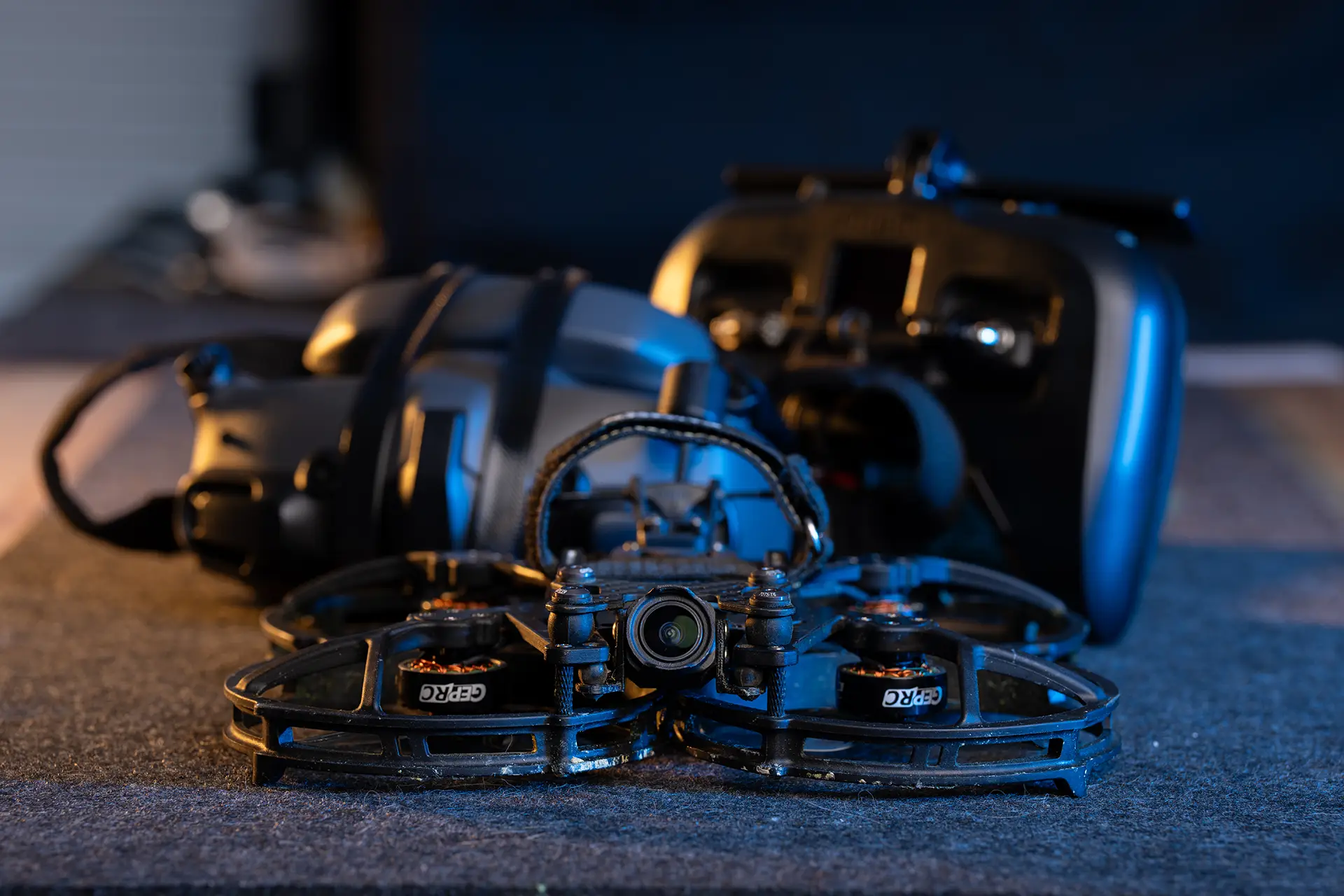
FPV Drone - Cinelog 35 V2.
The Cinelog 35 V2 is our cinematic FPV quad — the one that flies through doorways, dives off rooftops, and chases cars. It produces a kind of single-take motion a standard drone physically can't.
Specs
- Type
- Ducted 3.5-inch cinewhoop FPV quad (GEPRC Cinelog 35 V2)
- Airframe
- 3K carbon fiber frame with full prop guards around 3.5-inch props
- Weight
- About 309 g bare; roughly 365 g once an action camera and its mount are added
- Power
- 6S LiPo, typically 1300 mAh
- FPV link
- DJI O3 Air Unit digital HD video transmission
- Flight time
- Roughly 5 to 6 minutes per pack with a GoPro-class camera aboard
- Navigation
- GPS-assisted return-to-home and failsafe
A camera that flies like a camera operator.
An FPV drone is flown first-person through goggles, with the pilot seeing exactly what the aircraft sees. There is no gimbal quietly correcting the pilot's mistakes and no lens pointed politely at the horizon. The entire aircraft is the camera, so the shot is the flight path. That is the whole point: an FPV move can dive off a rooftop, thread a doorway, drop through a stairwell and end tight on a face, all in one unbroken take that no jib, gimbal or conventional drone can produce.
The Cinelog 35 V2 is a cinewhoop, which means the propellers sit inside ducts rather than hanging off open arms. Ducts cost some efficiency and add weight, and we accept both, because they are what make it reasonable to fly a few feet from a wall, a car, a vehicle or a group of people. It carries an action camera on top for the recorded footage while the onboard digital FPV link gives the pilot a clean, low-latency view to fly from.
Where we reach for it.
We do not put an FPV quad on every job. It earns its place when a shot needs to move through a space instead of over it, or when a single continuous take has to carry a lot of story.
- One-take venue reveals that start outside and finish inside, with no cut
- Automotive work, where the aircraft can hold a line beside or behind a moving car
- Through-the-doorway and through-the-window transitions between two spaces
- Descending dives down the face of a building, a job site or a piece of terrain
- High-energy establishing shots for live events and brand pieces
What we plan around.
Flight time is short. With a camera on board, a pack is good for roughly five or six minutes, and the useful window is shorter than that once you subtract launch, positioning and landing margin. So an FPV shot gets rehearsed. We walk the line first, agree on the start and end frame, fly it several times and pick the take. That preparation is not overhead, it is the job. The upside of a small ducted quad is that it will fly the same line repeatedly without complaint until the take is right.
Rules, and flying it safely.
In the United States, flying a drone for commercial purposes requires an FAA Part 107 remote pilot certificate, and aircraft in this weight class have to be registered. Airspace near an airport needs authorization before the props spin. Beyond the legal floor, close-proximity FPV is a crewed activity: we brief the people in frame, keep a visual observer on the aircraft, and treat prop guards as a supplement to distance rather than a replacement for it.