Monitors
Ninja V Monitors.
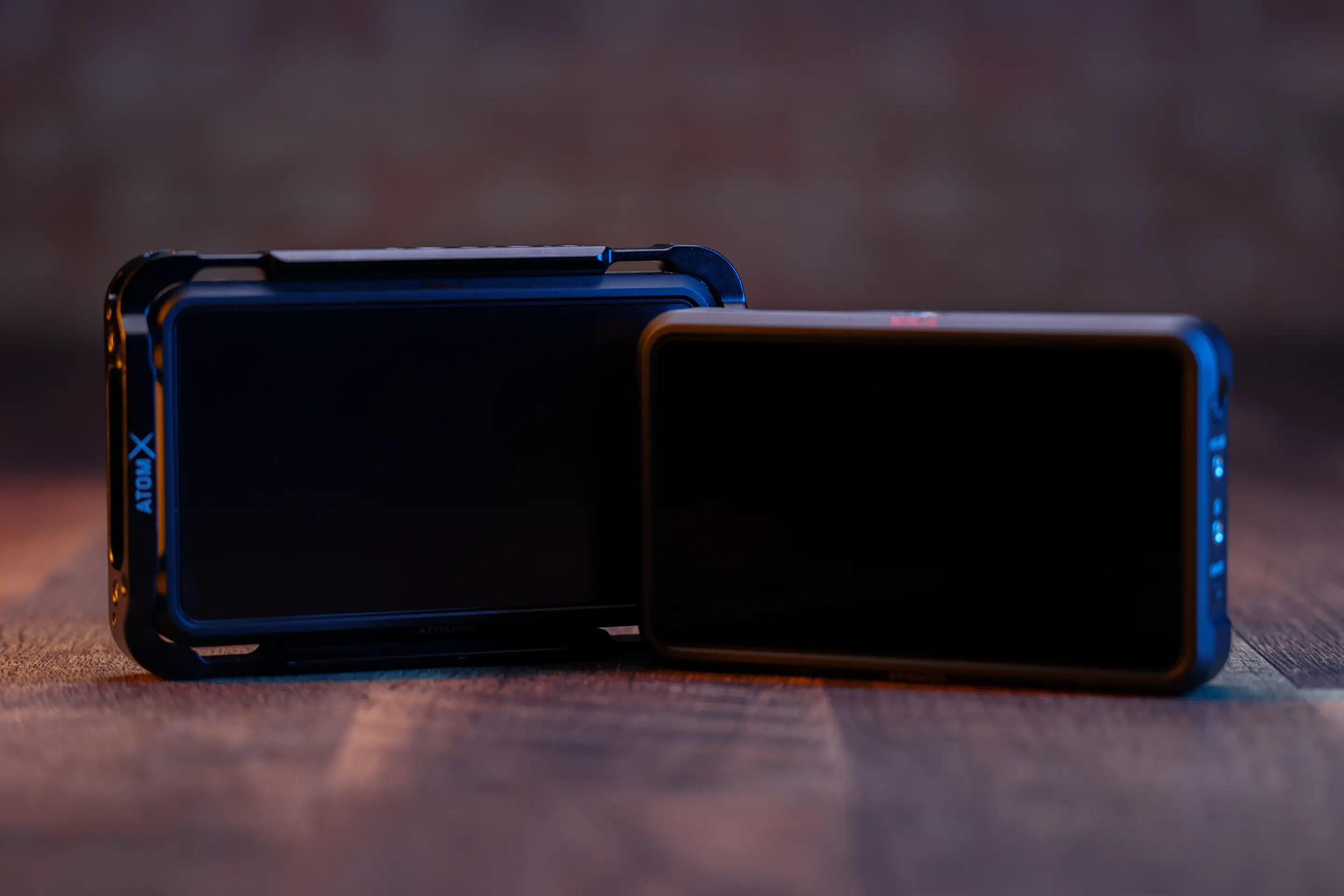
Atomos Ninja V monitor-recorders give us a large, accurate view of the frame plus external recording, with scopes, waveforms, and LUT preview for on-set colour decisions.
Specs
- Screen
- 5-inch 1000-nit 1920x1080 touchscreen
- Input
- HDMI 2.0, up to 4K 60p 10-bit
- Recording codecs
- Apple ProRes and Avid DNxHR
- Media
- SATA SSD (AtomX SSDmini and compatible drives)
- Power
- Sony L-series (NP-F) battery
A monitor and a recorder in the same box.
The Atomos Ninja V is the small screen that ends up on most of our camera builds. It is a 5-inch, 1000-nit touchscreen that doubles as an external recorder, taking a clean 4K 60p 10-bit signal over HDMI 2.0 and writing it to a SATA SSD as Apple ProRes or Avid DNxHR. That combination is the reason we own several of them rather than a stack of dumb monitors: the same unit that lets the director see the frame is also the unit that captures the master file.
Recording externally is not always necessary, but when it is, it saves real time. ProRes and DNxHR are edit-ready formats, so footage drops straight onto a timeline without a transcode pass. On a long corporate or interview day, cutting the ingest step out of post is worth more than it sounds.
Seeing the image properly.
Most of the value of an external monitor is in judgment calls you cannot make on a small camera screen. At 1000 nits the Ninja V stays readable in daylight, which matters because a washed-out screen leads to washed-out decisions about focus and exposure.
It is also how we monitor log footage honestly. Log is flat and low-contrast by design, and eyeballing exposure from a flat image is guesswork. Loading a LUT on the Ninja gives us a rough view of the graded look while the camera still records the full-latitude file underneath.
- Focus peaking and punch-in for critical focus on interviews and product work
- False colour and waveform to set exposure rather than guess at it
- LUT preview so log footage can be judged as a finished image
- Frame guides for social crops when a piece will be delivered vertically as well as wide
- Playback on set, so we can confirm a take before the crew moves on
How it lives on our rigs.
The Ninja V is small and light enough to sit on top of a mirrorless body without turning it into a two-hand job, and it runs off the same Sony L-series batteries we already carry, so the on-set power situation stays simple. On a gimbal or shoulder build it moves to an arm where the operator can actually see it.
It is not the right tool for everything. When a client or director needs to watch from across the room, we move to wireless video instead. But as the operator's screen, and as a backup or primary recorder on a shoot where the file matters, the Ninja V does two jobs well and adds only one thing to the rig.