Lenses
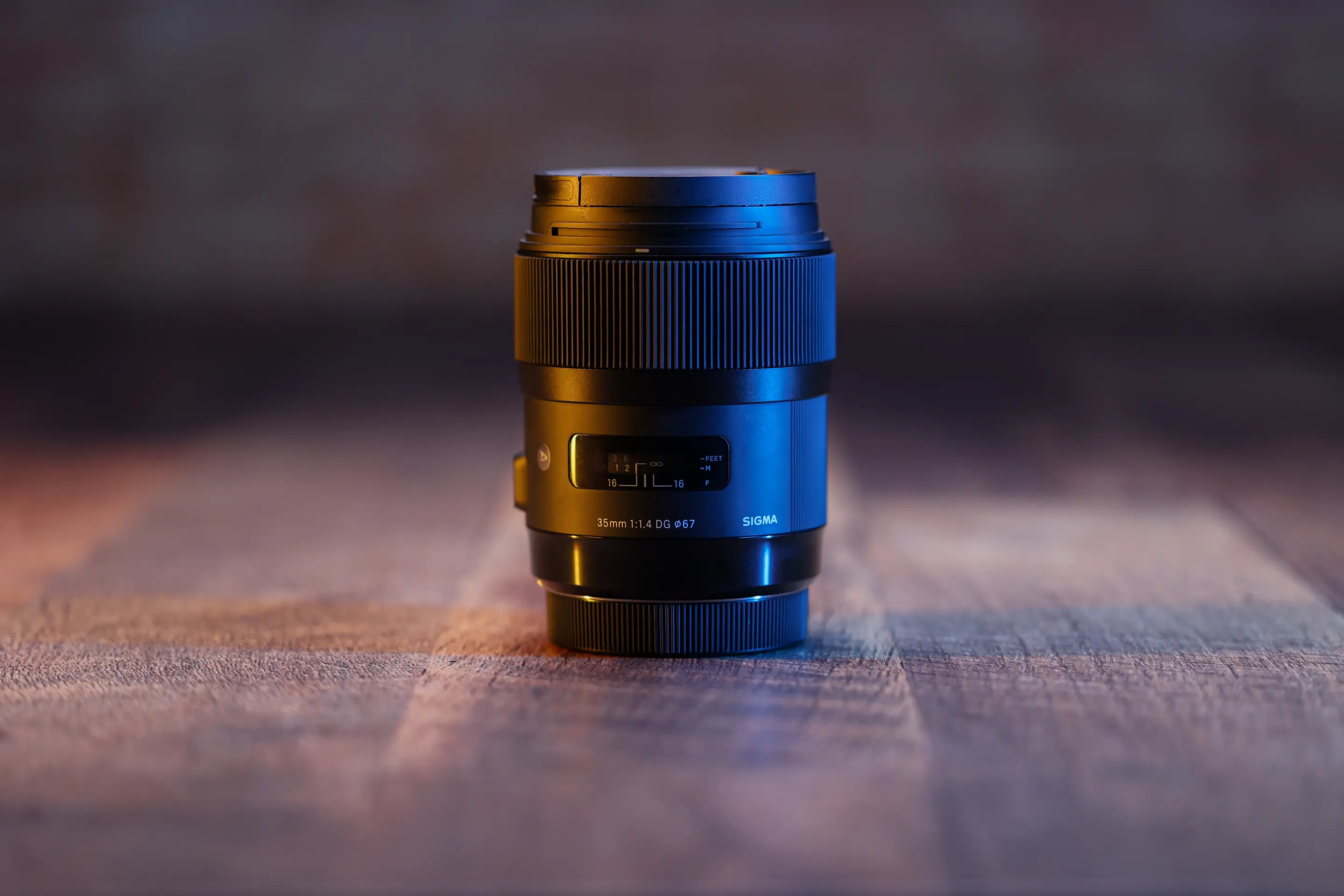
Sigma 35mm f/1.4.
The Sigma 35mm f/1.4 is a fast prime that keeps enough of the room in frame to tell the story while still throwing the background soft. A favourite for interviews and environmental portraits.
Specs
- Focal length
- 35mm
- Maximum aperture
- f/1.4
- Minimum aperture
- f/16
- Diaphragm blades
- 9, rounded
- Minimum focusing distance
- 30cm (11.8 in)
- Filter size
- 67mm
- Lens construction
- 13 elements in 11 groups
A wide lens that still holds a subject.
35mm is the focal length that shows a person and the room they are standing in at the same time. That is why the Sigma 35mm f/1.4 Art gets pulled out of the case more than almost anything else we own. It is wide enough to give a shot context — the venue, the shop floor, the crowd behind the couple — without the stretched, fish-eyed look that a true wide-angle puts on faces near the edge of the frame.
The f/1.4 aperture is the reason it earns a slot in a working bag rather than a shelf. Receptions are dark. Barn venues out past Prosser are dark. Church interiors in Spokane are dark. Being able to open up to f/1.4 means we can hold a usable shutter and a clean ISO instead of pushing the sensor until the image turns to mud, and the background falls away enough that a busy room reads as atmosphere rather than clutter.
What we shoot with it.
- Getting-ready coverage in hotel rooms and small suites, where there is no space to back up
- Dance floors and low-light reception moments, handheld and close to the action
- Environmental portraits — a business owner in their own space, a senior on location
- Commercial and brand B-roll where the product and the setting need to be in the same shot
- Second interview angles, cut against a longer lens for a wider, more grounded look
How it behaves on set.
Wide open, this lens has a real depth-of-field cost. At f/1.4 with a subject a few feet away, the plane of focus is thin, and a person leaning six inches forward will walk out of it. On documentary-style wedding coverage we usually work between f/1.4 and f/2.8 depending on how much a subject is moving, and stop down further when two or three people need to be sharp in the same frame. That is a discipline thing, not a flaw — it is what a fast prime asks of you.
It focuses down to about a foot from the front element, which is close enough for detail inserts — rings on a table, hands on a keyboard, a product on a countertop — without swapping lenses mid-sequence. It is also a solid, dense piece of glass, heavier than the plastic-barrel primes people start out with. We consider that a fair trade for the way it holds up to being carried through a nine-hour day.
Why we keep it in the kit.
Most of our work in the Tri-Cities and across the Pacific Northwest happens in rooms we did not design and cannot rebuild. A fast 35mm is how we make those rooms look intentional: close enough to feel present, wide enough to explain where we are, fast enough to keep shooting after the sun goes down.