Misc
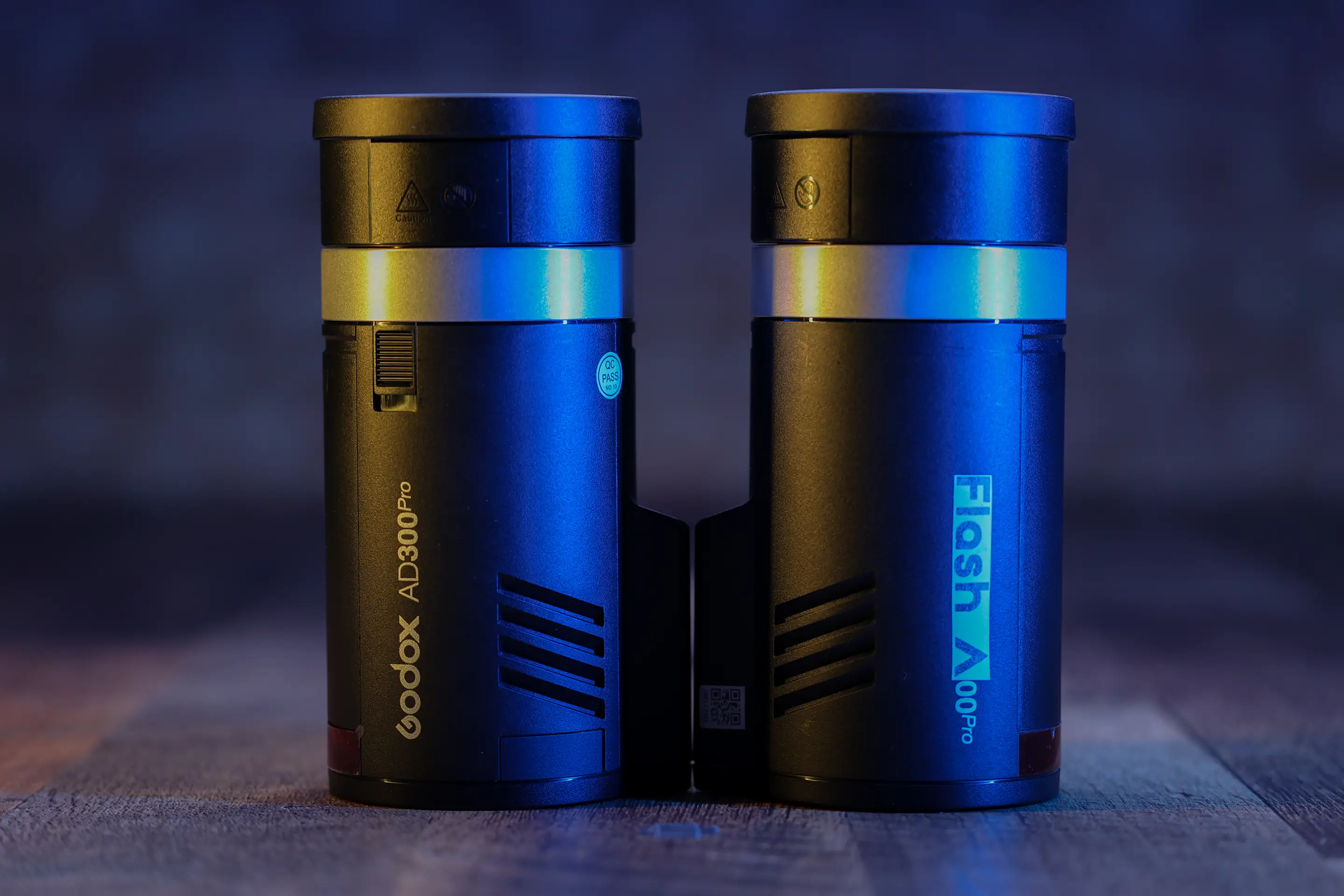
AD300 Pro.
The Godox AD300 Pro is our battery-powered strobe. It gives us studio-grade light on location — no wall outlet required — for portraits and product work.
Specs
- Power
- 300Ws
- Power range
- 9 stops, 1/1 to 1/256
- Recycle time
- 0.01 – 1.5 sec
- Battery
- 14.4V / 2600mAh Li-ion, approx. 300 full-power flashes
- Sync
- TTL, 2.4GHz wireless, HSS to 1/8000 sec
- Colour temperature
- 5600K daylight-balanced
Studio light with no wall to plug into.
The AD300 Pro is a 300Ws battery-powered strobe, and the reason it lives in the kit is simple: it gives us a real studio light in places that have no power. A field, a parking garage, a barn, the shoulder of a road at golden hour. No generator, no extension cords snaking across a venue floor for someone to trip over, no negotiating with a facilities manager about which outlet is on which breaker. You set it down, you turn it on, you shoot.
300 watt-seconds is the useful middle of the range. It's genuinely enough to overpower midday sun on a portrait subject with a modifier attached — which is the entire trick behind an outdoor image that looks lit rather than snapshot — while staying small enough that one person can carry a light, a stand and a modifier in one trip. Anything much bigger stops being a location light and starts being a truck.
The numbers that actually matter on a shoot.
Recycle time runs from 0.01 to 1.5 seconds. At the power levels we normally use it, that means the strobe is ready before the shutter is. You are never standing in front of a client waiting for a light to catch up, and on a wedding day — where the formal portrait window is fifteen minutes and shrinking — that is the difference between getting the shot and getting an apology.
Power adjusts across nine stops, from full down to 1/256, so it works as the key on a hard-lit automotive shot and as a whisper of fill on an interview. The battery is rated for roughly 300 full-power flashes, and since we're rarely running full power, real-world life is far longer than that number suggests. HSS syncs to 1/8000 of a second, which is what lets us shoot wide open in bright sun and keep a shallow background instead of stopping down to f/11 and losing the separation entirely.
Where we reach for it.
- Outdoor portraits and wedding formals where the ambient light is either too harsh or too flat.
- Automotive shoots, where a hard, controllable source is what makes a body panel read.
- Commercial and brand stills on location, in spaces with no usable power.
- Real estate — a bounced strobe to lift interiors without the colour mess of mixed household bulbs.
- Corporate headshots shot on site, where the whole studio has to fit in a conference room and be gone by lunch.
It also carries an adjustable modeling light, which sounds like a footnote and isn't. Being able to see where the light is falling before you fire it is how you place a light quickly, and speed on location is the whole game.