Storage
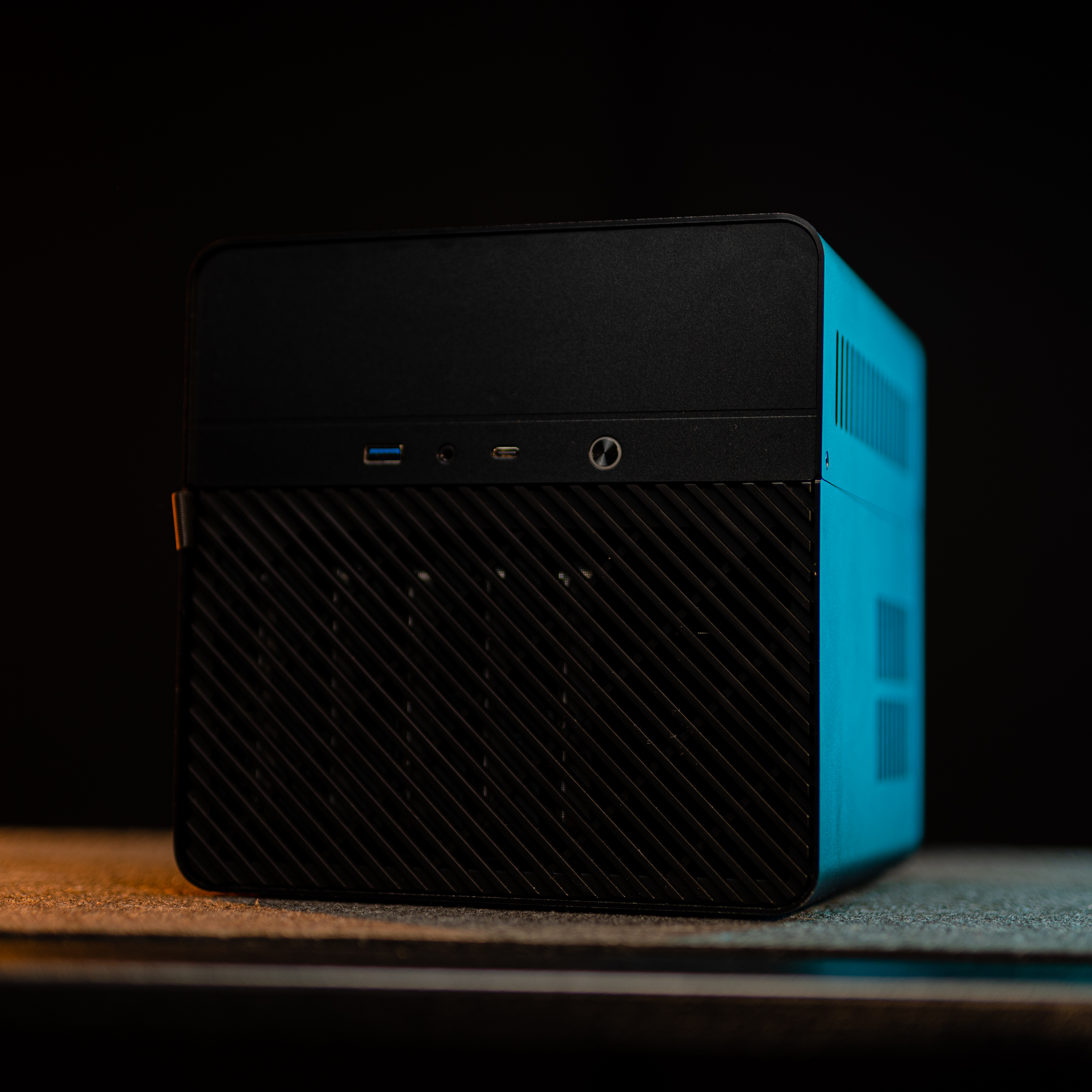
100TB NAS.
Our 100TB network-attached storage server is the archive behind every project. Redundant drives mean a disk failure doesn't cost a client their wedding film or campaign footage.
Specs
- Capacity
- 100TB
- Type
- Custom-built network attached storage (NAS)
- Role
- Primary studio archive for camera originals and finished deliverables
- Resilience
- Redundant disks — a single drive failure does not lose data
The archive everything lands on.
Every frame we've ever shot ends up here. The NAS is a custom-built, roughly 100TB storage server that sits in the studio and holds the camera originals, the audio, the project files and the finished deliverables for every job. It's not a convenience — it's the thing that means a client can call two years after their wedding and ask for a still from a moment we didn't put in the film, and the answer is yes rather than a long silence.
We built it ourselves rather than buying an appliance because storage at this scale is one of the few problems in this business where the right answer is fully knowable. You can reason about how many drives you need, how much redundancy the work is worth, and what happens when a disk dies. We've written up how we approach data management for creatives in our lab notes, because the reasoning is more useful than the parts list — the specific hardware will be obsolete long before the logic is.
Redundancy is the whole point.
Hard drives fail. Not sometimes — eventually, all of them. A NAS with redundancy built in assumes that from day one: it spreads data across multiple disks in a way that survives losing one of them. A drive dies, the array keeps serving files, we swap the dead disk and the array rebuilds itself. Nobody's wedding film disappears because of a component that costs less than a lens filter.
What redundancy is not, though, is a backup. A redundant array protects against a disk failing. It does nothing about a fire, a theft, a flood, or someone deleting the wrong folder — those events take the whole box with them. So the NAS is one layer, not the only one.
- Camera originals stay in their original structure, untouched, exactly as they came off the card.
- Finished deliverables and project files are archived alongside the source, so a job can be reopened, not just re-watched.
- Redundant disks mean a single drive failure is a maintenance task, not an emergency.
- Footage is only cleared off the field SSDs once it is confirmed on the archive.
- The array is monitored — a failing disk is something we find out about before it fails, not after.
Why we tell clients about it.
Most people never ask where their footage lives. They should. The gap between a production company that has a real archive and one that has a stack of unlabelled externals in a closet only becomes visible on the day you need something back, and by then it's too late to have wanted it. The NAS is the least visible thing we own and one of the most important.