Lenses
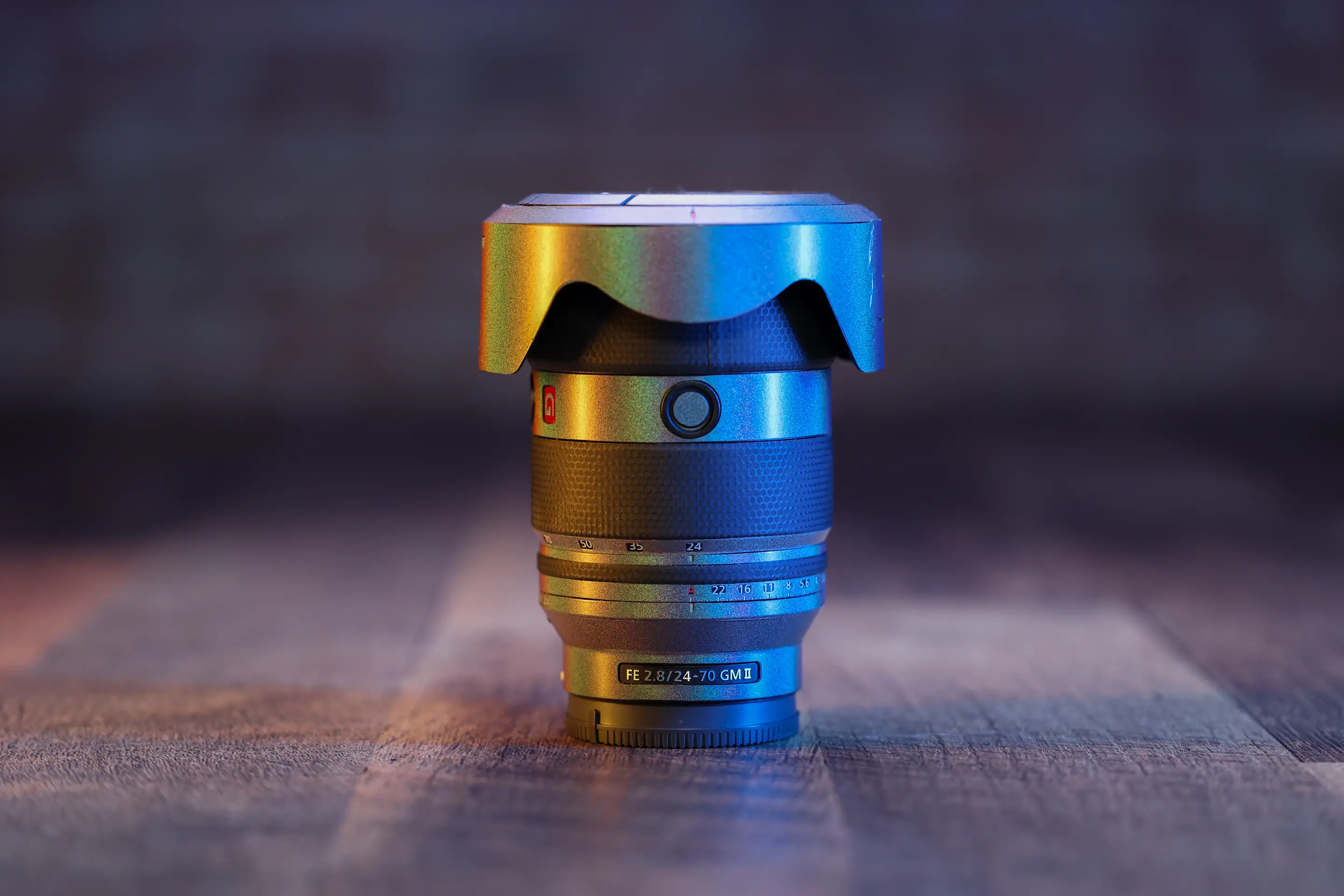
Sony 24-70GM II.
The Sony 24-70mm G Master II is the workhorse zoom on our Sony bodies — wide enough for a room, long enough for a portrait, sharp across the range. If we could only bring one lens, this would be it.
Specs
- Focal length
- 24-70mm (full-frame, Sony E-mount)
- Maximum aperture
- f/2.8, constant through the zoom range
- Minimum aperture
- f/22
- Optical design
- 20 elements in 15 groups
- Aperture blades
- 11, circular
- Minimum focus distance
- 0.21m at 24mm
- Filter thread / weight
- 82mm / 695g
The lens that's already on the camera.
If we could only take one lens to a job, this is it. The Sony FE 24-70mm f/2.8 GM II covers wide enough to hold a room and long enough to shoot a clean waist-up frame, at a constant f/2.8, which means it handles most of a wedding day, most of a corporate shoot, and most of a commercial B-roll session without a lens change. On a fast-moving day — prep, first look, ceremony, portraits, reception — the time you don't spend swapping glass is time you spend covered.
The reason this particular version replaced everything else in our kit is weight. At 695g it is dramatically lighter than the standard f/2.8 zooms of a few years ago, and that changes what's possible: it balances on a gimbal without a fight, it doesn't wear you out over an eight-hour wedding, and it doesn't rebalance the rig when you zoom. Sony also fitted it with four linear motors, and autofocus is quick and quiet enough that it isn't a factor when you're rolling audio in a quiet ceremony.
What we shoot with it.
- Wedding and quinceañera coverage — prep, ceremony, reception, the whole day on one lens
- Corporate and brand video, including sit-down interviews framed at the 70mm end
- Real estate interiors at 24mm and detail work at 70mm without changing lenses
- Senior portraits and headshots where we need to move fast and reframe on the fly
- Gimbal work, where the light weight and steady balance keep moves clean
The controls that matter on a video day.
This is one of the few stills-first zooms that was clearly designed with filmmakers in the room. The aperture ring has a click on/off switch, so we can de-click it and change exposure smoothly mid-take instead of stepping through stops. An iris lock keeps the ring from being knocked into the A position by accident. There are two customizable focus-hold buttons, a zoom-ring tension switch, and a manual focus ring with linear response — meaning the same rotation always produces the same focus change, which is what makes a repeatable rack focus possible.
Where its limits show.
There's no optical stabilization in this lens, so handheld video relies on the body's in-body stabilization — fine for most work, worth planning around for a long handheld take. And 70mm is a portrait focal length, not a telephoto one: if we need real background separation or reach across a big room, we're on the 70-200mm instead. But for the other 80 percent of a shooting day in the Pacific Northwest — a wedding in Richland, a brand shoot in Seattle, an interview in a Spokane office — this is the lens that stays mounted.